
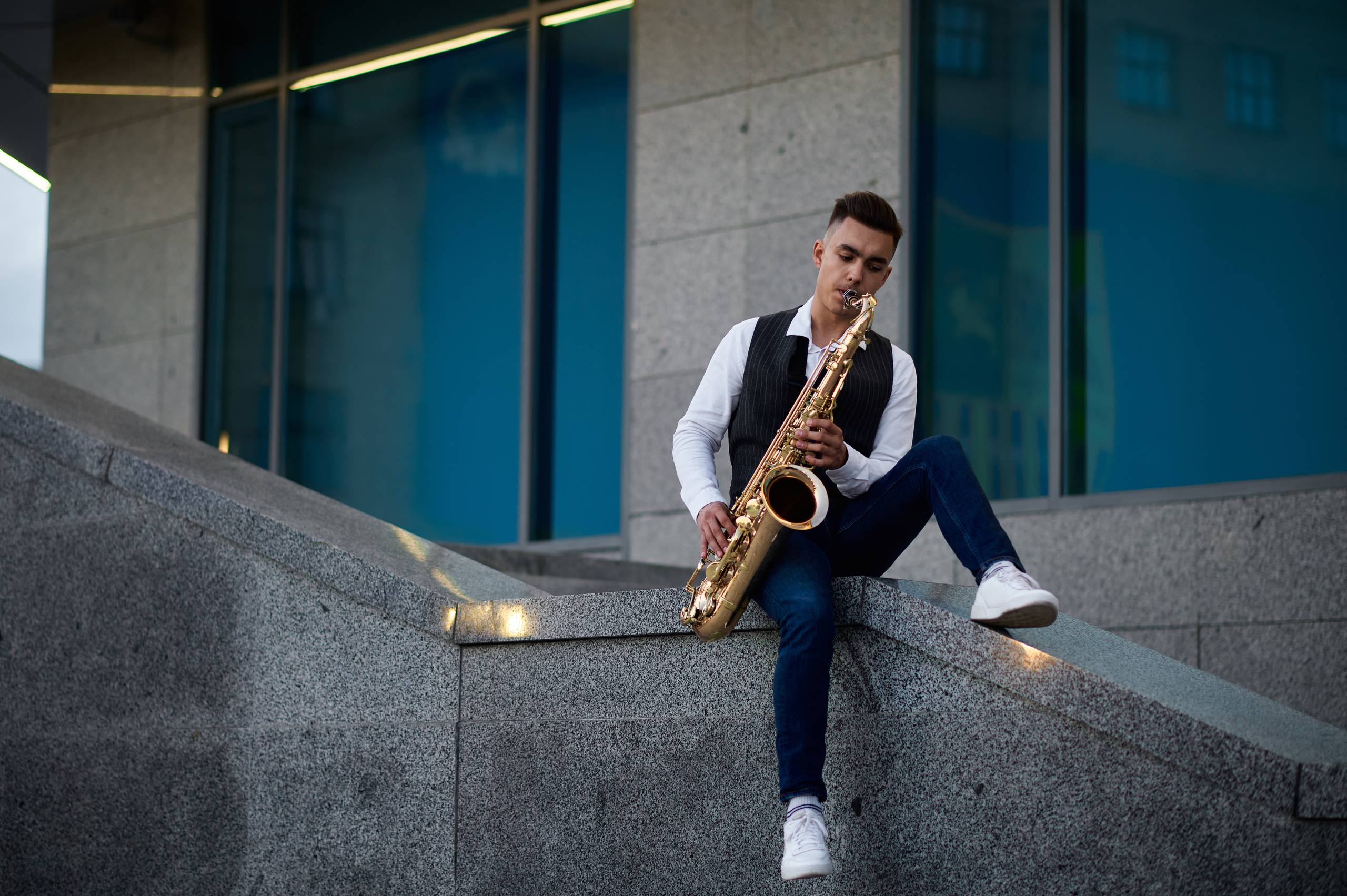
You won’t become a confident saxophonist because you don’t get nervous, you will because you’ve practiced being a performer so many times that your nerves convert to adrenaline that heightens your performance. Most saxophonists practice for a long time and when they go to play in front of other people they realize that performing is a completely different ball game. You need to practice it. Start with one person. Play for your wife or your best friend. Take a selfie video of yourself improvising over a tune for 16 bars and post it on Instagram. Sit in on the local jam session. All of these will become good memories which you will use to fight the fear of failure. Eventually you will practice enough so that the fear of failure doesn’t paralyze you anymore.
Focus on your mental game: it’s just as important as getting your reeds and chops ready. I encourage all the saxophonists I work with to imagine themselves successfully executing each piece they will be performing just before they get on stage. Take a couple of moments to breathe, feel your breath support your playing, hear your sound, see your fingers navigating the keys with ease. I also remind my students to communicate with themselves constructively in the moments leading up to going on stage. Instead of thinking, “I’m going to crack that note,” try saying to yourself, “I’ve practiced this piece well and I’m excited to perform it.” Deep breathing also helps. Try doing it throughout the day and in the moments before you take the stage. It will help you keep your body relaxed and your air stream full when adrenaline takes hold.
This is one of the single most important pieces of advice I can give to anyone who wants to develop a genuine performance confidence. It’s all too easy to kid yourself about how you go when you practice and perform. Recording yourself is a way to listen back to how you really went. Don’t go into harsh critic mode on the first listen – have a listen for the things you did well, and then have a second, more critical listen. I’m sure you’ll be surprised to find that some performances that felt like they were a catastrophe were actually quite good, and some things that felt like they were going okay could do with some attention. Regular recording and critique of your playing will help you improve faster and give you confidence that you’ve prepared well for performances. Over time, the performances will feel more like extensions of your practice, rather than the be-all-and-end-all of your work.
Finally, ensemble performance in jazz is an incredible confidence builder in its own right, since, because of the responsibility shared with others and the nature of the conversation, the individual psyche doesn’t have the time and space to dwell on its own vulnerability. Performing in a group setting, whether it be with a rhythm section or other horn players, requires the player to learn to adapt their musical statements to the rhythm section, to be sensitive to the various non-verbal cues that they will inevitably encounter, and to learn to be a member of the team rather than the featured performer. All of these processes and their rewards provide positive reinforcement in the moment to the musician, and help them to remember that music is about communication rather than perfection.
Essentially, the key to performance confidence is to play the saxophone as a means of self-expression instead of as a way to validate yourself as a sax player. It’s the culmination of a number of gigs in front of a number of crowds and in a number of situations and settings. It’s the knowledge that you can have an off day and still sound good, but really, the most powerful gigs come from someone who is willing to be vulnerable enough to just blow their own ass off despite any mistakes they might be making. It’s playing regularly and having the balls to let your personality shine through your playing and trying to be there in the moment whenever you step up onto the bandstand. Instead of stage fright, there’s stage excitement, and there’s nothing quite as rewarding as that feeling of reaching people with your music.