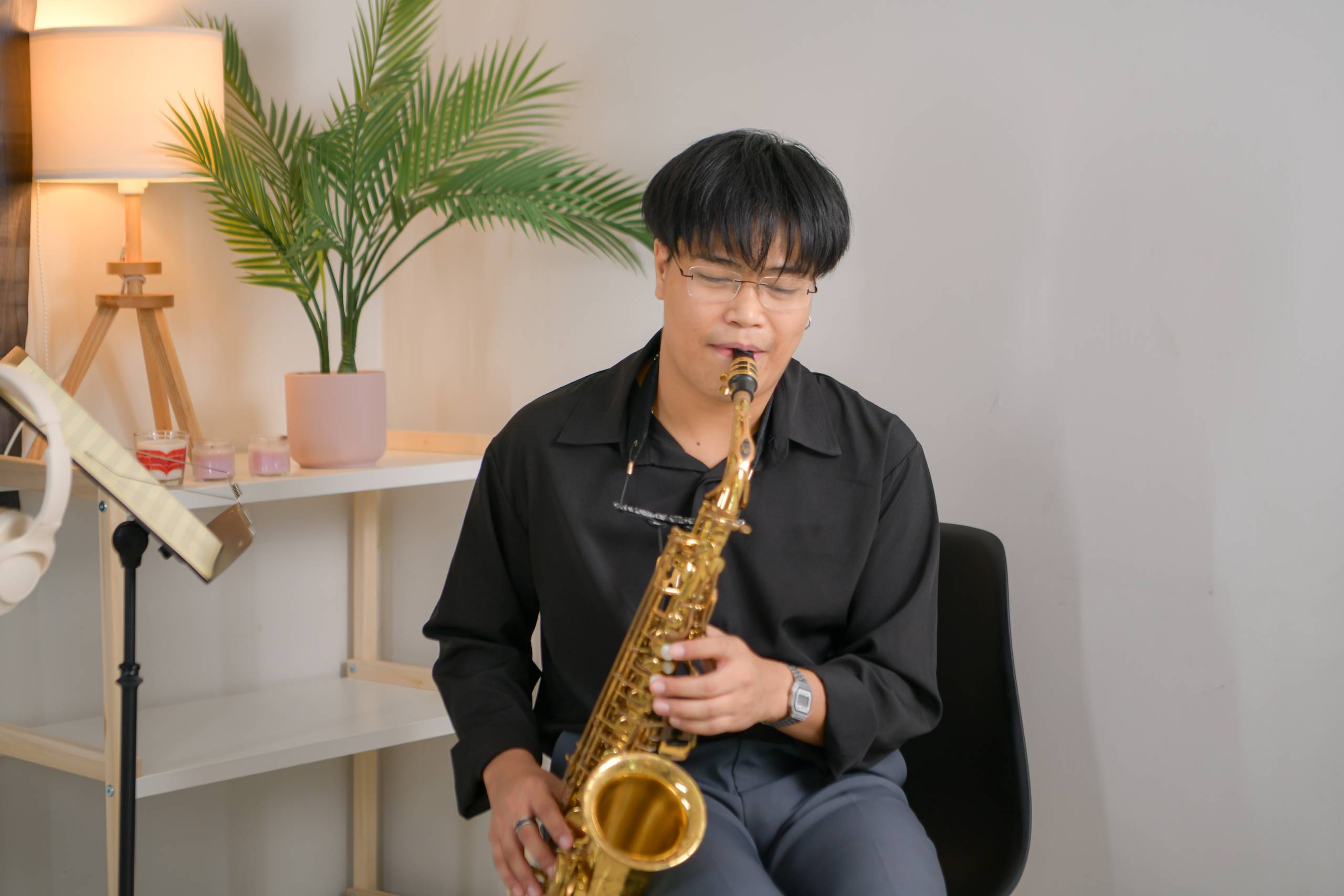
Supporting every great saxophone solo or performance is the often overlooked element of breathing technique. A saxophonist with poor breath support might not be able to consistently produce a good tone or play with much feeling. First, you have to learn to use your diaphragm in breathing. This will help you support the airflow into the instrument and avoid using your embouchure muscles to push the air through the reed. This will reduce your fatigue while playing and also give you the ability to produce a wider range of dynamics. Practicing long tones and deep breathing exercises will help you develop the technique of breathing, which will in turn help you to more freely express the music you play.
We practice breathing. Eventually, you start with simple things like diaphragm breathing to get accustomed to the use of that muscle. When you breathe deeply, and you’re standing straight, it’s your lower stomach that should expand, not your shoulders, since that tightens the body and reduces volume. Eventually, that extends to circular breathing for sustained parts in difficult songs, or controlling air pressure for vibrato. This is one of those things that is true across all genres. Whether you’re playing Moon River or the Clarke Technical Studies, this is important. My teacher is always saying to record yourself, so you can notice the difference.
A frequent difficulty is that it takes some time to get used to synchronizing the breath with the fingerings and embouchure changes. Students sometimes experience a fluttering or a breaking of the sound, but after practicing scales with different dynamics, for example, this problem usually ceases. The best way is to practice it globally during daily practice sessions and warm-ups, so it becomes automatic. Once it has been mastered, the resulting length of phrases will allow us to play complex repertoire without reducing it. It will mean that we have more freedom and expressivity to communicate with our flute.
Lastly, good breathing also enables a lot of the artistic expression needed for the saxophone. The ability to play notes for the right length and with the right feel are dependent upon your ability to control your breathing, which also helps you keep time in a group. A good soloist also needs to be able to control their breathing to give the audience the impression they want. You find out that breathing is a big deal for music after a while. It affects the tone of the saxophone, timing, and so on. Learning about it early on will help your musical career with a saxophone in the long run.
Finally, a dedication to breath control allows the saxophonist to view the instrument as a part of themselves and breathe life into the music. Once mastered, the breath empowers the saxophonist to try new styles of music, perform with others, and learn music. With a mastery of the breath, the music will come alive for other listeners and allow them to tell the stories of the past, present, and future.